
In a July 2026 podcast interview, Oliver Cookson questioned his reasons for starting a second sports-nutrition business. Having built and sold Myprotein, he said, he started Go Nutrition a few years later. Looking back, he described it as “built from the wrong place” and called it a Myprotein “me-too company”. He was questioning his motivation for launching Go Nutrition, which operated in much the same category as Myprotein.[1]
At the time, Cookson had offered a different explanation: he missed the sports-nutrition industry, believed its products could improve and wanted to operate without outside investors. Both accounts are his. Their difference does not prove that the earlier one was dishonest.[2]
Go Nutrition entered a market Cookson knew from the inside. He founded Myprotein in 2004 after comparing retail supplement prices with ingredient costs. A former web developer, he built an online store around transparent product information, lower prices and customer relationships. He initially handled coding, products and orders himself.[3]
By 2011, those decisions had produced something a larger acquirer wanted. The Hut Group, an online retailer with a shared technology and fulfilment platform, acquired Myprotein in May. Its announcement emphasised the product range, established European websites and the ability to sell to its existing six-million-customer database. Cookson was expected to join the group board and oversee its enlarged lifestyle division. The buyer was purchasing a functioning business and a route into a category, not merely the founder's reputation.[4]
The £58 million was not a cheque
The reported £58 million acquisition price needs unpacking. Myprotein was traded through a company called Cend. An English High Court judgment from a later dispute records that Cookson personally held 100,000 voting A shares, while the trustee of his Jersey family trust held 100,000 non-voting B shares. Both interests were sold to The Hut Group under a share purchase agreement dated 31 May 2011. It was a sale of the operating company's equity, not a £58 million personal cash payment.[5]
The same judgment describes The Hut Group's April 2011 indicative offer: an enterprise value of £58 million, comprising £30 million in cash and shares in the combined group then valued at £28 million, representing a proposed 12% stake. Those were terms of an initial non-binding offer, not a substitute for the final completion statement. The judgment confirms that the completed deal involved cash split between Cookson and the trust, with shares in The Hut Group issued to the trust. It does not establish in the passages reviewed the founder's final net cash after all allocations, costs and tax.[5]
The share component carried exposure to a different business. Cookson exchanged control of Myprotein for cash and a minority interest in its acquirer. The transaction subsequently produced litigation over financial warranties. The court record reports that The Hut Group admitted a breach of warranties relating to the value of consideration shares. The seller's financial outcome was still contested after ownership had changed.[5]
Cookson later told New Business that he initially preferred a minority investment and chose The Hut Group partly to retain economic exposure to growth. This is his retrospective account, not a complete bidding record. The Hut Group reported £16 million in Myprotein revenue during the seven months after acquisition in its 2011 trading update. That measures the buyer's post-close contribution, not Cookson's proceeds.[3][6]
A second company in the same aisle
Go Nutrition launched in 2013. Cookson returned to familiar ground: powders and sports supplements, online customers, price comparisons, flavour development and arguments about ingredient quality. In a founder's letter posted to a fitness forum, he promised improved natural flavours, price matching and money-back guarantees. He also said he had personally invested millions of pounds. His stated investment has not been independently verified.[2]
Customers noticed the resemblance. In the forum, one asked why Cookson had sold Myprotein only to launch another supplement website. He answered that he missed the industry. Another questioned whether Go Nutrition could beat a passive investment. Cookson replied that investment returns were not his principal reason for starting it. He wanted to work in nutrition again.[2]
The marketing advantage was different when Go Nutrition launched in 2013. Cookson's original insight at Myprotein had been an under-served online distribution model and a large retail markup. At Go Nutrition, the internet was no longer a novel route to market, and Myprotein was itself an established competitor. Go Nutrition's claim therefore depended less on inventing a new commercial channel than on executing known tactics better: flavours, packaging, pricing and service. The founder's experience was an advantage, but it could not recreate the original market conditions.[2][3]
Supreme Imports acquired Go Nutrition in June 2019. The buyer claimed more than 800 products, 50,000 customers across Europe and distributors in 30 countries across EMEA and Asia. Its announcement did not publish the price, profitability, purchase-price allocation or whether it bought assets rather than company shares. An acquisition occurred; that announcement cannot establish whether Cookson made or lost money.[7]
In 2026, Cookson characterised that chapter more critically. His description of Go Nutrition as a copy does not establish that its products were poor or that the buyer received little value. It is a statement about the venture's origin. Nor does it tell us precisely whether he wanted to recover his former routine, compete with the company he had sold or demonstrate that he could repeat the achievement. Those are plausible readings, but he did not assign those motives separately in the available interview. His contemporaneous claim that he missed the category is more securely documented.[1][2]
When the product came first
Verve was his third nutrition business. Cookson told the same 2026 interviewer that he used to assemble a daily mixture of numerous nutritional ingredients for himself. A friend saw what he was preparing and suggested selling it. Verve's initial product translated that habit into a single greens drink with a founder-reported 80 ingredients. This was again a nutrition business. The difference, in his telling, was that he had first made the product to solve a problem in his own routine.[1]
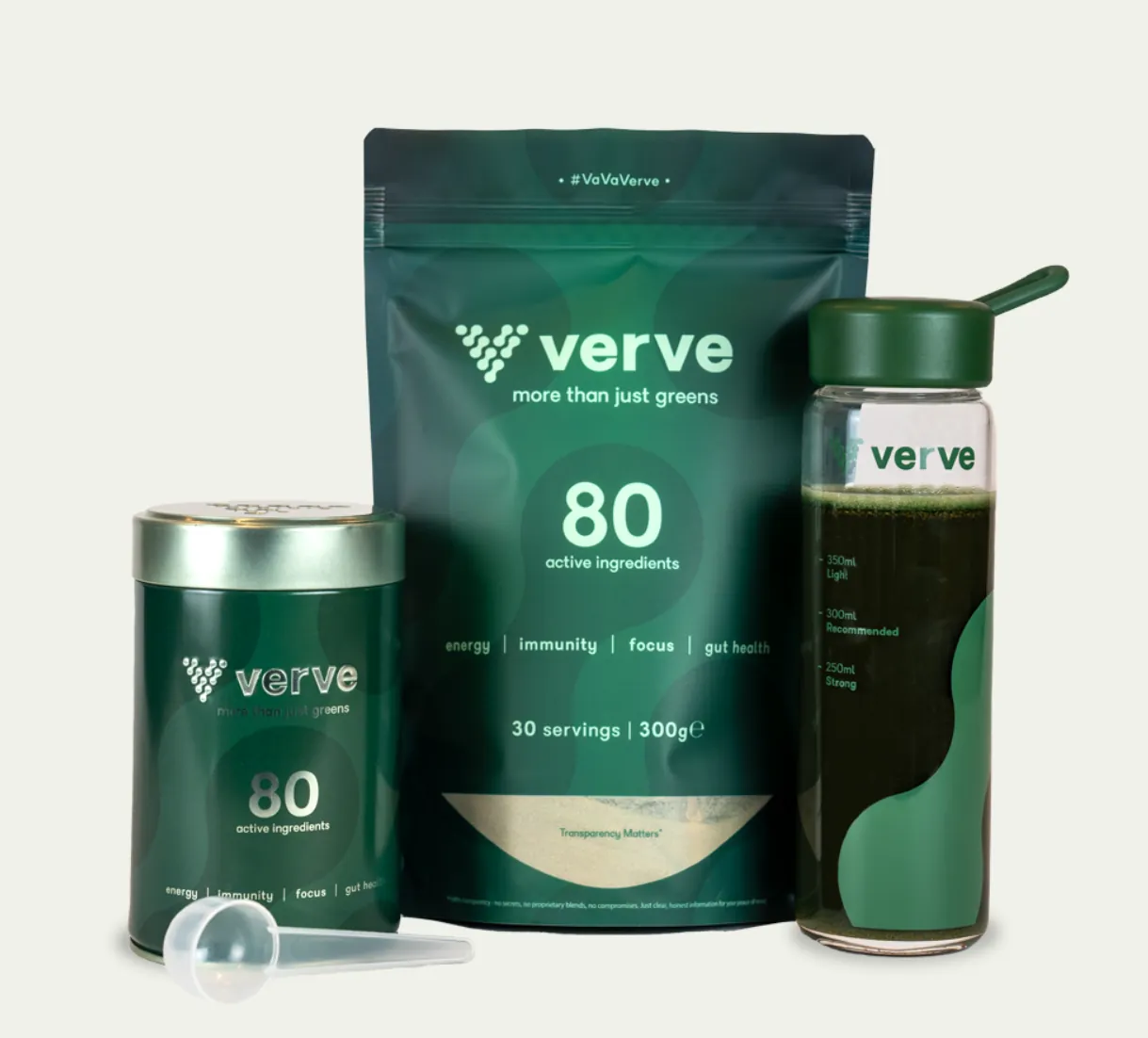
Cookson announced Verve publicly in 2023 as a daily nutrition product rather than a conventional protein seller. He described friends whose kitchens were crowded with supplement pouches and bottles and promoted a policy of listing ingredient amounts instead of concealing them within proprietary blends. Ingredient-label transparency can be inspected; clinical benefits, superior health outcomes and commercial advantage require separate evidence. The founder's statements about formulation should not be converted into independent validation of those claims.[8]
The commercial model still depends on recurring orders, digital customer acquisition and brand credibility. Its risks include formulation costs, retention, distribution and competition. The reviewed public documentation does not provide audited Verve revenue, customer-acquisition costs or profits. Cookson's greater conviction about its origins is not proof of commercial success.[8][9]
The operating background remained consistent. All three businesses drew on Cookson's knowledge of nutrition and online retail, and each sought to make a case for product transparency. The initial commercial hypotheses were different. Myprotein began with a retail-price discrepancy, Go Nutrition with a familiar operating opportunity, and Verve with a mixture the founder was already making. Myprotein's early test was whether lower prices could attract online buyers. Go Nutrition had to win customers in a more mature market. Verve depends on repeat purchases of a product derived from Cookson's routine. Each company still had to prove that its customer economics were sustainable.
Cookson sold his first company without severing all of his economic ties to it. He then built in its shadow before identifying a more personal problem to solve. Cookson has demonstrated that he can launch successive nutrition brands. Whether Verve can sustain repeat orders and profitable customer acquisition remains unproven in the public figures reviewed.
Original exhibit / The Second Act
Three businesses, three reasons to begin.
A comparison of documented product origins and commercial tests, without inferring undisclosed profitability or private motivation.
Primary references: Cookson interviews and founder statements [1–3, 8–9], THG and court documents [4–6], Supreme's buyer statement [7].